Album of the Week - Atom Heart Mother
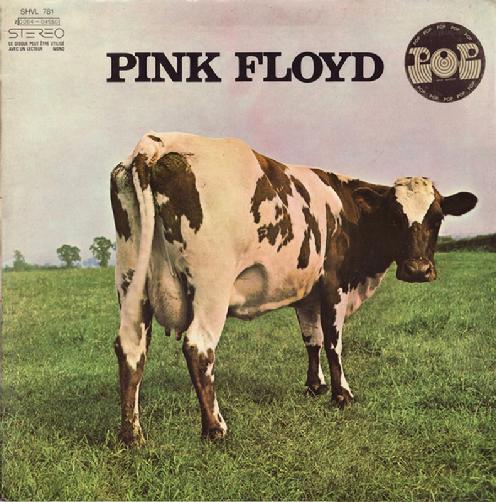
Atom Heart Mother is the fifth studio album by the English progressive rock band Pink Floyd. It was released by Harvest on 2 October 1970 in the UK, and by Capitol on 10 October 1970 in the US. It was recorded at Abbey Road Studios in London, England, and was the band's first album to reach number 1 in the UK, while it reached number 55 in the US, eventually going gold there. A remastered CD was released in 1994 in the UK and the United States, and again in 2011. Ron Geesin, who had already influenced and collaborated with Roger Waters, contributed to the title track and received a then-rare outside songwriting credit.
The cover was designed by Hipgnosis, and was the first one to not feature the band's name on the cover, or contain any photographs of the band anywhere. This was a trend that would continue on subsequent covers throughout the 1970s and beyond.
Although it was commercially successful on release, the band, particularly Waters and David Gilmour, have expressed several negative opinions of the album in more recent years. Nevertheless, it remained popular enough for Gilmour to perform the title track with Geesin in 2008.
Atom Heart Mother was released on 2 October 1970 in the UK and 10 October in the US. It reached number 1 and number 55, respectively in those countries' charts. It was released in the quadraphonic format in the UK, Germany and Australia. A remastered CD was released in 1994 in the UK and the US.
"When the fat old sun in the sky is falling. Summer evenin' birds are calling. Summer's thunder time of year The sound of music in my ears. Distant bells, new mown grass Smells so sweet. By the river holding hands Roll me up and lay me down. And if you sit don't make a sound. Pick your feet up off the ground. And if you hear as the warm night falls. The silver sound from a time so strange. Sing to me, sing to me."
Critical reaction to the suite has always been mixed, and all band members have expressed negativity toward it in recent times. Gilmour has said the album was "a load of rubbish. We were at a real down point ... I think we were scraping the barrel a bit at that period" and "a good idea but it was dreadful... Atom Heart Mother sounds like we didn't have any idea between us, but we became much more prolific after it." Similarly, in a 1984 interview on BBC Radio 1, Waters said "If somebody said to me now – right – here's a million pounds, go out and play Atom Heart Mother, I'd say you must be fucking joking."
In a 1970 review, Alec Dubro of Rolling Stone appraised Atom Heart Mother negatively, stating "if Pink Floyd is looking for some new dimensions, they haven't found them here." In Christgau's Record Guide: Rock Albums of the Seventies (1981), Robert Christgau said the suite was easier to digest than the second side of songs: "Yeah, they do leave the singing to an anonymous semi-classical chorus, and yeah, they probably did get the horns for the fanfares at the same hiring hall. But at least the suite provides a few of the hypnotic melodies that made Ummagumma such an admirable record to fall asleep to." The album is ranked number 990 in All-Time Top 1000 Albums.
The band were initially enthusiastic about performing the suite. An early performance was taped for the San Francisco television station KQED, featuring just the band, on 28 April 1970. Two major performances were at the Bath Festival of Blues and Progressive Music on 27 June and the "Blackhills Garden Party" in Hyde Park, London on 18 July. On both occasions the band were accompanied by the John Alldis Choir and the Philip Jones Brass Ensemble. Later, the band took a full brass section and choir on tour just for the purpose of performing this piece. However, this caused the tour to lose money, and the band found problems with the hired musicians, which changed from gig to gig as they simply took who was available, which, combined with lack of rehearsal and problems miking up the whole ensemble, made a full live performance more problematic. Reflecting on this, Gilmour said "some of the brass players have been really hopeless". According to Mason, the band arrived at one gig in Aachen, Germany, only to discover they had left the sheet music behind, forcing tour manager Tony Howard to go back to London and get it.